
- Published on
Community Forums vs Feature Voting Boards
- Authors

- Name
- Gabriel P.
- @gabriel__xyz
Community Forums vs Feature Voting Boards
Community forums and feature voting boards help SaaS companies manage user feedback, but they serve distinct purposes:
- Community Forums: Encourage open discussions, peer support, and knowledge sharing. Users troubleshoot issues, share ideas, and build a searchable knowledge base. However, they require active moderation and can become cluttered with off-topic or duplicate threads.
- Feature Voting Boards: Organize feedback into structured lists where users can suggest and vote on features. This helps product teams identify trends and prioritize development. They provide clear data but require regular maintenance to avoid becoming outdated or biased by popular opinions.
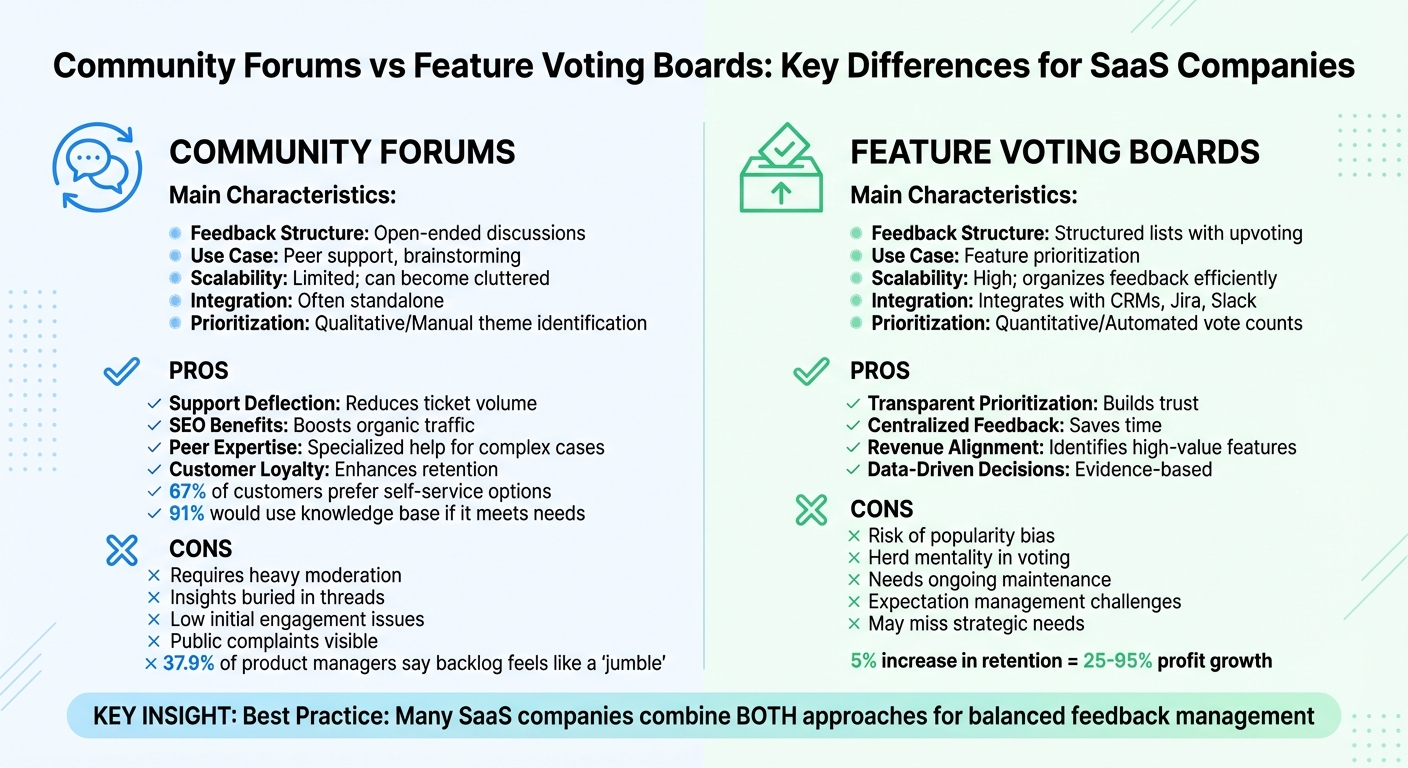
Key Difference: Forums are better for fostering broad user interactions, while voting boards excel at gathering and prioritizing structured feedback to guide product roadmaps.
Quick Comparison:
| Factor | Community Forums | Feature Voting Boards |
|---|---|---|
| Feedback Structure | Open-ended discussions | Structured lists with upvoting |
| Use Case | Peer support, brainstorming | Feature prioritization |
| Scalability | Limited; can become cluttered | High; organizes feedback efficiently |
| Integration | Often standalone | Integrates with CRMs, Jira, Slack |
| Challenges | Requires heavy moderation, insights buried | Risk of popularity bias, needs upkeep |
Choosing the right tool depends on your goals. Forums are ideal for community engagement and qualitative feedback, while voting boards streamline feature prioritization and align feedback with business objectives. Many SaaS companies combine both for a balanced approach.
Features.Vote - Canny alternative for feature voting boards and roadmap
What Are Community Forums?
Community forums are online spaces where users come together to discuss specific topics in an organized way. They act as central hubs where customers can talk about a product, share their experiences, and help each other troubleshoot. Unlike private support tickets or scattered social media interactions, forums create a structured, searchable archive of discussions that anyone can access.
For SaaS companies, forums double as self-service knowledge bases, helping reduce the need for direct customer support. When one user asks about a feature or reports a bug, the response becomes a resource for others in the future. This turns forums into a valuable repository of shared knowledge.
Forums also play a big role in product development. They encourage collaborative brainstorming between users and product teams. As Discourse points out, forums allow participants to refine “early ideas” into informal specifications through ongoing discussions. This process complements more structured tools like voting boards and helps prioritize features effectively.
Let’s dive deeper into their key features and potential challenges.
Key Features of Community Forums
What makes forums so useful for SaaS companies? Let’s break it down.
Forums organize conversations into threads, making it easier for users to follow specific topics. Each thread typically features user-generated content, member profiles that highlight contributions and roles, and a robust search function that turns past discussions into a handy knowledge base. To keep users engaged, many forums also include gamification features like badges, ranks, or leaderboards, rewarding active participants and encouraging long-term involvement.
When forums are well-maintained and offer valuable content, they can drive traffic and boost user participation. Research shows that 67% of customers prefer self-service options over contacting support, and 91% of users are likely to use a knowledge base if it meets their needs [8].
Common Challenges with Community Forums
While forums offer many benefits, they’re not without their hurdles. One major issue is keeping discussions organized. Conversations can easily go off-topic, duplicate existing threads, or bury important insights. This makes manual moderation essential to prevent spam and keep content relevant.
Running a forum also requires ongoing resources. A successful forum needs a team of administrators, community leaders, and advanced moderation tools to maintain quality and address conflicts as the community grows. Without active moderation and clear rules, forums can quickly spiral into chaos or stagnate.
Another challenge lies in extracting actionable insights from open-ended discussions. While forums are great for gathering qualitative feedback, it’s harder for product teams to sift through the noise and prioritize features compared to more structured feedback systems. These obstacles can sometimes limit how effectively forums support user engagement and product development in SaaS settings.
What Are Feature Voting Boards?
Feature voting boards are platforms where users can suggest product ideas, vote on features they want the most, and leave comments explaining their needs. Unlike community forums that often host wide-ranging discussions, these boards focus on one goal: helping product teams identify which features are most important to users. Instead of creating repetitive threads, users upvote existing ideas, allowing the most popular requests to rise to the top. This gives product managers clear, data-driven insights into user demand.
The real value of voting boards lies in their ability to close the feedback loop. When a feature progresses from "Under Consideration" to "Planned" or "Shipped", everyone who voted for it gets notified. This not only makes users feel heard but also strengthens customer loyalty. In fact, research shows that increasing customer retention by just 5% can boost revenue by up to 95% [4].
For SaaS companies struggling to manage feedback scattered across emails, Slack, and support tickets, voting boards serve as a centralized hub. They turn unorganized suggestions into actionable, structured data that can guide product decisions.
How Feature Voting Boards Work
Users submit feature requests through a dedicated portal where others can browse ideas, cast votes, and add comments to explain how specific features would benefit them. This process generates both quantitative data (vote counts) and qualitative insights (user comments).
Product managers then use this data to prioritize their roadmap. Rather than reacting to the latest complaints, they analyze trends from a broader pool of user input. For example, in 2025, Mercury's Senior Product Designer Ida Ström highlighted how voting boards reveal recurring issues:
"This is something that's not just the support agent experiencing this, but we've seen it across 20 or 30 people. So the voting has been super helpful too." [1]
Advanced voting boards allow segmentation by customer type, such as distinguishing feedback from enterprise clients versus free-tier users. This ensures that prioritization aligns with business goals. Teams further refine the board's functionality by merging duplicate requests and archiving ideas with little traction.
However, votes alone shouldn’t dictate decisions. As Jesse Sandala, Director of Product at GiveButter, explained when managing over 600 votes for their "Auctions" feature in 2022:
"We assigned the effort score and strategic importance to achieve a more balanced ranking for our roadmap." [1]
This approach helps validate user demand while ensuring that decisions align with broader company strategies. By following this process, SaaS companies can improve transparency, streamline workflows, and boost customer retention.
Why SaaS Companies Use Feature Voting Boards
Feature voting boards bring three major benefits to SaaS companies: transparency, efficiency, and stronger customer retention.
Transparency builds trust. When users can track a request's progress from "Submitted" to "Shipped", they see that their input matters. Even marking some requests as "Not Planned" helps set clear expectations.
Efficiency saves time. Instead of addressing feedback scattered across multiple channels, product teams can direct users to a single board. The community itself often helps by identifying duplicate ideas and consolidating feedback.
Retention drives revenue. By focusing on features that matter most to high-value customers, companies can reduce churn. When users see their requests implemented - and receive notifications about updates - they feel more connected to the product, fostering long-term loyalty and growth.
Feature voting boards aren’t just about gathering feedback - they’re about building stronger relationships with users while making smarter product decisions.
Key Differences Between Community Forums and Feature Voting Boards
Community forums thrive on open-ended, threaded discussions where users can exchange ideas and provide peer support [6]. In contrast, feature voting boards organize feedback into structured lists, allowing users to upvote requests, which helps uncover demand trends [1][5]. The difference in how these tools are structured significantly influences how they handle feedback prioritization.
Forums often require manual effort to sift through conversations and identify recurring themes. This approach tends to amplify the "loudest voices" rather than capturing the broader user base [1][11]. On the other hand, voting boards rely on vote counts - often weighted by metrics like Monthly Recurring Revenue (MRR) - to highlight scalable trends [1][4]. For instance, when Mercury transitioned from tracking feedback in Notion to a voting board, Senior Product Designer Ida Ström discovered that what seemed like an isolated support request was actually backed by 20 to 30 users [1].
Scalability is another area where these tools diverge. Voting boards streamline feedback by merging duplicate suggestions and categorizing ideas, making it easier to manage thousands of requests efficiently [1][5]. In contrast, forums can become cluttered with redundant threads as they grow. Productboard noted this challenge:
"Feature voting forums failed us. All the noise, duplicate requests, griping and complaints limited their value for collecting inputs from the broader user community" [11].
Additionally, forums typically function as standalone platforms or as extensions of support helpdesks [6]. Meanwhile, voting boards integrate seamlessly with tools like Salesforce and Jira, linking user feedback directly to revenue data and development workflows [1][10].
Comparison Table: Forums vs Voting Boards
| Factor | Community Forums | Feature Voting Boards |
|---|---|---|
| Feedback Structure | Unstructured, threaded discussions and peer Q&A [6][11] | Structured lists of requests with upvoting [1][5] |
| Prioritization Method | Qualitative/Manual (theme identification in threads) [6] | Quantitative/Automated (vote counts weighted by MRR) [1][4] |
| Primary Use Case | Support, community building, and brainstorming [6] | Roadmap validation and feature request management [5][9] |
| Scalability | Low; becomes noisy and cluttered at scale [11] | High; organizes large volumes of feedback into trends [1][5] |
| Integration Potential | Standalone or linked to support helpdesks [6] | Integrated with CRMs (Salesforce), Slack, and Jira [1][10] |
These differences underscore the importance of aligning your tool choice with your SaaS's feedback management goals. The right approach depends on whether your priority is fostering community discussions or efficiently managing feature requests.
Pros and Cons of Community Forums
Community forums are a cost-effective way to handle support by leveraging peer-to-peer troubleshooting. Nicole Saunders, Senior Manager of Communities at Zendesk, highlights their efficiency:
"If the user asks us a question and somebody else answers it, boom - there's a ticket that didn't get submitted because another user answered them" [12].
This approach is especially effective for addressing complex issues, where seasoned users often offer insights that even internal support teams might not have. However, while the benefits are clear, forums also come with challenges that need careful consideration.
One major advantage is the content these discussions generate. Every thread becomes searchable, driving organic traffic to your site. According to research, 88% of companies say community forums improve their overall customer experience [12], and 91% of customers indicate they would use a knowledge base if it met their needs [8]. Saunders also emphasizes the long-term benefits:
"In the long run, most communities can have a positive impact on things like customer retention, longevity, and lifetime revenue - the more users feel connected to each other, the more loyal they are" [12].
But forums aren't without their downsides. They demand constant moderation. Without dedicated community managers, forums can quickly spiral into spam, misinformation, or even public complaint zones - issues that are visible to both potential customers and competitors. Additionally, the unstructured nature of forum discussions can make it hard for product managers to extract useful insights. In fact, 37.9% of product managers admit their backlog feels like a "jumble" [3]. Important feedback often gets buried, requiring significant manual effort to identify trends.
Another challenge is the influence of vocal users. These dominant voices can overshadow the needs of the broader customer base. On the flip side, forums that lack activity can discourage new users, leaving a poor first impression.
Community Forums: Pros and Cons Table
Here’s a breakdown of the advantages and challenges of community forums, along with their impact on SaaS businesses:
| Pros | Impact on SaaS Business | Cons | Impact on SaaS Business |
|---|---|---|---|
| Support Deflection | Reduces ticket volume, lowering support costs | Moderation Burden | Requires staff to manage spam and maintain quality |
| SEO Benefits | Boosts organic traffic through indexed discussions | Noise & Fragmentation | Insights get buried in disorganized threads |
| Peer Expertise | Offers specialized help for complex use cases | Low Initial Engagement | Empty forums deter participation |
| Customer Loyalty | Enhances retention and increases lifetime value (CLV) | Public Complaints | Negative feedback visible to prospects and competitors |
| Direct Feedback | Helps shape the product roadmap with user insights | Slow Resolution | Peer responses may take longer than official support |
sbb-itb-87ea67c
Pros and Cons of Feature Voting Boards
Feature voting boards offer a structured way to gather and prioritize user feedback. One of their standout benefits is prioritization with transparency - they provide clear, data-supported insights into what users value most. Take Mercury, a banking platform for startups, as an example. They transitioned from scattered Notion threads to a voting system. According to Ida Ström, their Senior Product Designer, what initially seemed like isolated support requests turned out to be supported by 20 to 30 users. This shift gave the team the clarity they needed to justify decisions on their roadmap [1]. Unlike community forums, which often lack structure, voting boards excel at organizing feedback in a way that supports data-driven decision-making.
However, not everything about voting boards is smooth sailing. They can sometimes devolve into popularity contests. Without careful moderation, you might end up prioritizing features that appeal to free-trial users while neglecting the needs of your most valuable, paying customers. In 2022, GiveButter, a fundraising platform, faced this challenge with their "Auctions" feature, which racked up over 600 upvotes. Jesse Sandala, their Director of Product, balanced these votes with effort scores and strategic considerations to refine their roadmap effectively [1]. This example underscores the importance of blending quantitative data with qualitative insights to avoid falling victim to popularity bias.
Another issue is the herd mentality. Users often upvote features that are already popular, which can create a bias that overshadows niche but critical needs [2][9]. If these boards accumulate too many unaddressed requests, they can frustrate users instead of engaging them. To avoid this, votes should be treated as just one input among many. Combining vote counts with factors like revenue potential, development effort, and alignment with long-term goals can help ensure better decisions [1][5].
There’s also the matter of ongoing moderation. Voting boards require constant upkeep - merging duplicate requests, archiving outdated ones, and updating statuses. Without this effort, they risk becoming cluttered repositories of stale ideas, which can alienate users instead of fostering engagement [2][3]. But when managed well, the payoff can be huge. Even a small 5% increase in customer retention can result in profit growth ranging from 25% to 95% [9].
Here’s a quick summary of the key benefits and challenges of feature voting boards:
Feature Voting Boards: Pros and Cons Table
| Pros | Impact on SaaS Business | Cons | Impact on SaaS Business |
|---|---|---|---|
| Transparent Prioritization | Builds trust by showing users their feedback matters | Popularity Contest Risk | May prioritize popular features over strategic needs |
| Centralized Feedback | Saves time by consolidating requests from multiple channels | Herd Mentality Bias | Skews data as users upvote already-popular ideas |
| Revenue Alignment | Identifies features that drive upsells or reduce churn | Operational Overhead | Requires ongoing effort to manage and maintain the board |
| Customer Engagement | Strengthens retention by involving users in development | Expectation Management | Frustrates users if popular features aren’t delivered |
| Data-Driven Decisions | Justifies rejecting low-impact requests with evidence | Limited Strategic Scope | Votes may not account for feasibility or ROI |
While feature voting boards can be a powerful tool, they work best when paired with thoughtful moderation and a balanced approach to decision-making.
Use Cases for SaaS Businesses
Different tools cater to different aspects of user engagement. While community forums encourage open dialogue, feature voting boards bring structure to feedback. The choice between the two depends on whether your focus is collaborative discussions or organized feedback management.
When to Use Community Forums
Community forums shine when the goal is to foster broader, collaborative discussions. They’re perfect for taking rough ideas and turning them into actionable plans through ongoing conversations. As Paul Graham once said:
"Half the advice I give to startups is some form of 'talk to your customers'" [7].
Forums are especially effective for handling complex, open-ended feedback. Instead of reducing ideas to simple metrics, they allow for detailed discussions on topics like UX improvements, troubleshooting, and even design preferences. These forums often double as self-service hubs, where users assist one another, which can reduce the volume of support tickets. They also create a space where even negative feedback is welcomed, offering insights that traditional research methods might overlook. This continuous interaction with customers can be invaluable.
That said, while forums are great for deep discussions, there are times when a more structured approach is needed.
When to Use Feature Voting Boards
Feature voting boards are ideal for organizing scattered feedback. Whether it’s coming from emails, Slack messages, or support tickets, these boards centralize feedback into clear, actionable insights, cutting down on manual sorting.
One standout benefit is how they align feedback with revenue goals. Voting boards allow you to segment input based on customer value - helping you differentiate between enterprise clients and free-trial users. This segmentation provides data that can justify strategic decisions. For example, when Mercury adopted a voting system, they discovered that one feature request often represented feedback from 20–30 users [1]. This approach highlighted trends that might have otherwise gone unnoticed.
Additionally, voting boards help close the loop with customers. By notifying users when a feature moves from "planned" to "shipped", they build trust without requiring manual updates. And trust matters - research shows that even a 5% increase in customer retention can lead to profit increases ranging from 25% to 95% [9].
How Features.Vote Helps SaaS Businesses
Features.Vote simplifies feedback management by gathering input from various sources like emails, support tickets, and social media, then organizing everything into one streamlined platform. It also integrates directly into your SaaS application using customizable widgets, allowing users to submit ideas and vote without ever leaving your product.
Features.Vote: Key Benefits for SaaS
One standout feature is its ability to cut down on manual work. The platform automatically detects and merges duplicate requests, keeping your backlog tidy and manageable. For example, when Mercury transitioned from using Notion and Linear to a centralized voting system in August 2025, Senior Product Designer Ida Ström shared that the team gained valuable insights. They were able to see patterns where a single request was actually supported by input from 20 to 30 different users. This data-driven clarity helped them make roadmap decisions based on hard evidence rather than intuition[1].
Another game-changer is revenue-driven prioritization. Features.Vote lets you segment feedback by customer value, making it easy to distinguish between input from enterprise clients and free-trial users. GiveButter's Director of Product, Jesse Sandala, used this approach in 2022 to prioritize their "Auctions" feature, which had over 600 votes. By combining vote counts with effort scores and strategic importance, they successfully balanced user demand with business objectives[1].
The platform also closes the feedback loop automatically. When a feature moves from "planned" to "shipped", users are notified instantly. PixelMe used this functionality to keep their customers in the loop, which led to an improvement in their Net Promoter Score. This kind of automation not only saves time but also builds trust by keeping users informed[4].
Why Features.Vote Works Well for SaaS
Features.Vote stands out by offering transparency and smooth integration. Public roadmaps allow users to see what's in development, reducing support inquiries by making it clear that their requests are being addressed. For teams managing a growing volume of feedback, the Premium plan scales to meet those needs.
The in-app integration is another highlight. With an embeddable widget, users can provide feedback at the moment they encounter a need. This real-time, contextual approach boosts participation and ensures the feedback you receive is relevant and actionable. The analytics dashboard further enhances decision-making by showing which features resonate most with specific customer segments, helping teams identify trends they might otherwise miss. For added flexibility, private boards on paid plans let you gather structured input without revealing sensitive roadmaps to competitors.
Conclusion: Choosing the Right Tool for Your SaaS
Deciding between community forums and feature voting boards comes down to your specific goals. Are you aiming to foster collaborative discussions for deeper insights, or do you need clear, quantifiable data to shape your product roadmap? Forums excel at sparking open conversations and uncovering the "why" behind user needs[6]. Meanwhile, feature voting boards shine when it comes to collecting structured data that highlights the "what" and "how many" through vote counts and customer segmentation[1][4].
Many SaaS companies find success by combining these two approaches. Forums serve as a space for uncovering detailed user motivations, while voting boards focus on measurable priorities. Together, they provide a well-rounded view of user feedback. This combination ensures that decisions aren’t swayed by the most vocal users but are instead backed by both qualitative context and quantitative data. It also equips engineering teams with the insights they need to develop features effectively.
Relying solely on vote counts can lead to pitfalls like groupthink or prioritizing popularity over strategy. To avoid this, integrate vote counts with qualitative insights. This balanced approach ensures that your roadmap aligns with both customer needs and your company’s broader goals.
Tools like Features.Vote simplify the process by organizing scattered feedback and segmenting it based on customer value. They help tie product decisions to revenue impact, reinforcing the importance of turning raw feedback into actionable strategies[1][4].
The best tool for your SaaS depends on factors like your product’s stage, available resources, and market dynamics. Early-stage products might lean more on internal vision to guide development, while established products with a larger user base can benefit greatly from the structured insights of voting boards[5]. No matter which tools you choose - forums, voting boards, or both - active moderation and closing the feedback loop are essential. These practices ensure that user input translates into meaningful action, strengthening customer relationships and keeping your product aligned with market needs[2][9].
FAQs
::: faq
How can SaaS companies use community forums and feature voting boards together effectively?
Combining community forums with feature voting boards is a smart way for SaaS companies to gather detailed user feedback and understand feature priorities. Forums provide a space for open discussions where users can share ideas, ask questions, and point out challenges. When a specific feature suggestion gains traction in these conversations, it can be added to a voting board. This allows the wider user base to weigh in by voting, helping identify not just the most popular ideas but also the reasons behind the requests.
To make this work effectively, seamless integration is key. Embed voting boards directly within forum threads or link them in a way that keeps the user experience smooth and intuitive. Restrict voting to verified customers to ensure the feedback is relevant, group similar ideas to avoid redundancy, and keep users informed by regularly updating them on progress through a public roadmap. By combining the depth of forum discussions with the clarity of voting boards, SaaS companies can transform user feedback into meaningful product decisions while building trust and strengthening user engagement. :::
::: faq
What are the best practices for managing and moderating a community forum?
To keep a community forum thriving, start by establishing clear guidelines. These should spell out acceptable behavior, posting standards, and the consequences for breaking the rules. Clear rules not only set expectations but also help moderators handle situations fairly and consistently. Build a moderation team that includes both staff and trusted community members. Equip them with tools like spam filters and user-reporting features, and make sure they’re trained in conflict resolution.
Consistency matters. Stay on top of posts to quickly address issues like spam, harassment, or misinformation. Use a tiered moderation system to divide responsibilities, ensuring tasks are handled efficiently. Keep your community in the loop by sharing regular updates about moderation efforts and policy changes. Recognize and reward positive contributions - whether it’s highlighting helpful posts or giving shoutouts to active members.
To make the forum more user-focused, consider adding tools like embedded feature-voting boards. These let users suggest ideas and vote on what matters most, making the forum a powerful feedback channel. Monitor forum metrics, such as activity levels and response times, to spot trends and make improvements. By combining clear rules, consistent moderation, and user-driven feedback, you can create a safe and engaging space where your community thrives. :::
::: faq
How can feature voting boards help align product decisions with business goals?
Feature voting boards simplify the process of gathering and analyzing user feedback, helping product teams focus on features that align with their broader goals. By enabling users to share ideas and vote on what they value most, these boards reveal demand patterns and highlight which features are important to specific customer groups - whether it's high-value clients or those at risk of leaving.
Since voting data is tied to actual user accounts, product teams can connect their planning directly to key business metrics like customer lifetime value, potential revenue growth, or development costs. This approach not only helps justify investments but also ensures resources are allocated wisely and fosters transparency within the organization. Tools like Features.Vote make this even easier by embedding voting boards, public roadmaps, and widgets directly into apps, turning user input into actionable insights that lead to smarter product decisions and stronger business results. :::